Poco X8 Review: Big Battery, Bright Screen, but Performance Takes a Hit

This Xiaomi Poco X8 review finds a mid-range phone that gets the fundamentals of endurance and screen quality right, then stumbles where speed and camera flexibility matter. Florian Schmitt’s assessment for Notebookcheck, published on October 16, 2026, awards the device a 76% overall score, a rating of good. Xiaomi supplied the test unit through Xiaomi Deutschland.
Display and battery carry the phone

The 6.83-inch AMOLED panel is the Poco X8’s most persuasive feature. Resolution stands at 2772×1280, which works out to 447 PPI, and the screen refreshes at 120 Hz with 240 Hz touch sampling. In the APL brightness test, the panel measured around 1,000 cd/m2, with peaks reaching 1,116 cd/m2.
Dimming is not entirely comfortable for everyone. The display uses PWM at 125 Hz alongside high-frequency PWM that scales up to 3,840 Hz.
Battery capacity is unusually large for the class: 8,340 mAh. In the Wi-Fi runtime test, the phone lasted 29 hours and 29 minutes. Reader and idle use stretched to 50 hours, while sustained load reduced runtime to 5.2 hours. Wired charging is rated at 67 W, and the phone can supply 22.5 W of reverse wired charging. European buyers will not find a charger in the box, only a USB-C cable, a SIM tool and a protective case.
Durability claims go beyond the usual rating

Xiaomi has equipped the Poco X8 with both IP68 and IP69K ratings. TÜV SÜD certifies water resistance to a depth of 2 meters for 72 hours, and SGS certifies resistance to drops onto granite from up to 3 meters. Xiaomi also claims the battery has been tested across temperatures from -40 to +75 degrees Celsius.
The casing is largely plastic, and the white variant shows visible screws. At 223 g and 8.6 x 163.5 x 78.3 mm, the phone is not lightweight.
Software support is long, with ads included

Android 16 comes preinstalled. Xiaomi’s Security Center states that security patches will continue until 2032, a span of six years, and that five Android version upgrades are planned, reaching Android 21. The catch is that ads appear within the operating system.
Performance falls short of the predecessor
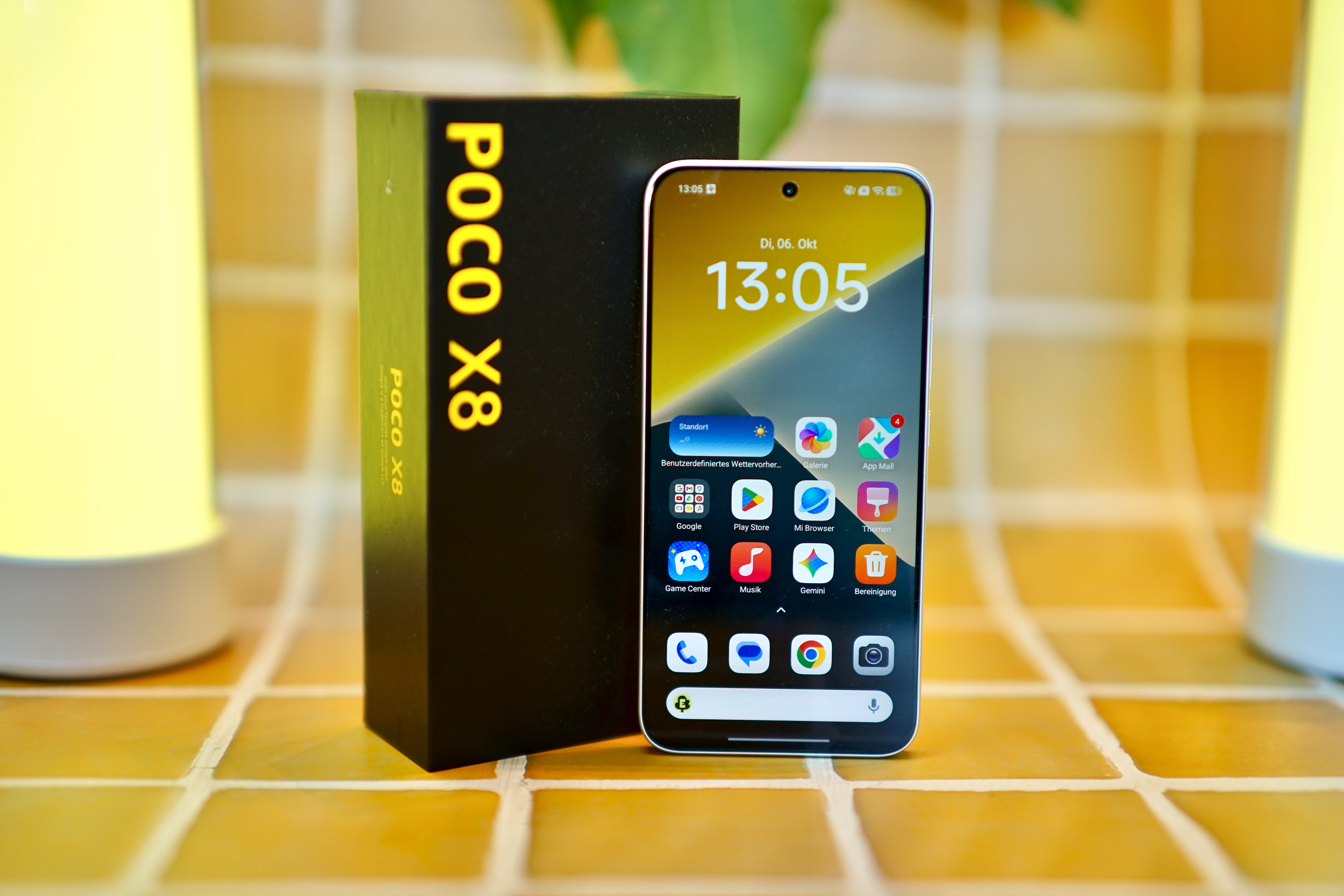
A Qualcomm Snapdragon 6s Gen 4 SoC and Adreno 710 GPU sit at the heart of the Poco X8, paired with either 8 GB or 12 GB of RAM and 256 GB of UFS 3.1 storage. There is no microSD slot.
Schmitt’s testing found performance weaker than the predecessor, and the phone is not stutter-free in daily use. Thermal management is better controlled: 3DMark stress tests showed about 99.5% stability, and surface temperatures peaked just under 42 degrees Celsius under load.
Camera hardware is limited
The main camera is a 50 MP f/1.8 unit with optical stabilization and phase-detection autofocus. A 2 MP depth sensor accompanies it. There is no ultra-wide-angle camera, and the predecessor’s wide-angle and macro cameras have been dropped. The front camera is 16 MP f/2.4. Video recording tops out at 1080p and 30 fps. quality is poor in low light.
Connectivity omits several modern standards
Wireless support is limited to Wi-Fi 5 (802.11 a/b/g/n/ac), with no Wi-Fi 7. Measured throughput was about 335 Mbit/s for transmit and 353 Mbit/s for receive. Bluetooth 5.1 is on board, and the USB port is USB 2.0 only, with no wired video output.
The phone takes dual nano-SIM cards but does not support eSIM. 5G is available, along with many LTE bands for international use. Single-band GNSS delivered outdoor accuracy of about 3 meters. Stereo speakers are hybrid in design and lean toward treble with little bass. An in-display fingerprint sensor and 2D face recognition handle biometrics.
Price and the Redmi alternative
At just under US$340, or 320 euros, the Poco X8 undercuts the Redmi Note 17 Pro 5G significantly. The two phones are similar, but the Redmi offers a wide-angle camera and eSIM, while the Poco offers more RAM options. European warranty runs for 12 months.
Xiaomi points to environmental, social and governance measures including plastic-free packaging, lower-CO2 transport and a self-repair program, though it provides no reliable environmental footprint figures.
The Poco X8 makes sense for buyers who prioritize a bright, large display and exceptional battery life, and who can accept modest performance, a limited camera system and older connectivity standards.










1 comment