Ugreen DXP2800 GT Review: 10GbE and Quiet Operation in a Two-Bay NAS

This Ugreen NASync DXP2800 GT review examines a compact two-bay network-attached storage device that carries hardware normally found in larger, more expensive systems. Daniel Schmidt evaluated the unit for Notebookcheck, and the review was published on 13 October 2026. Ugreen positions the DXP2800 GT for enthusiasts and small offices rather than for buyers who simply want occasional backups.
Hardware that exceeds the two-bay category
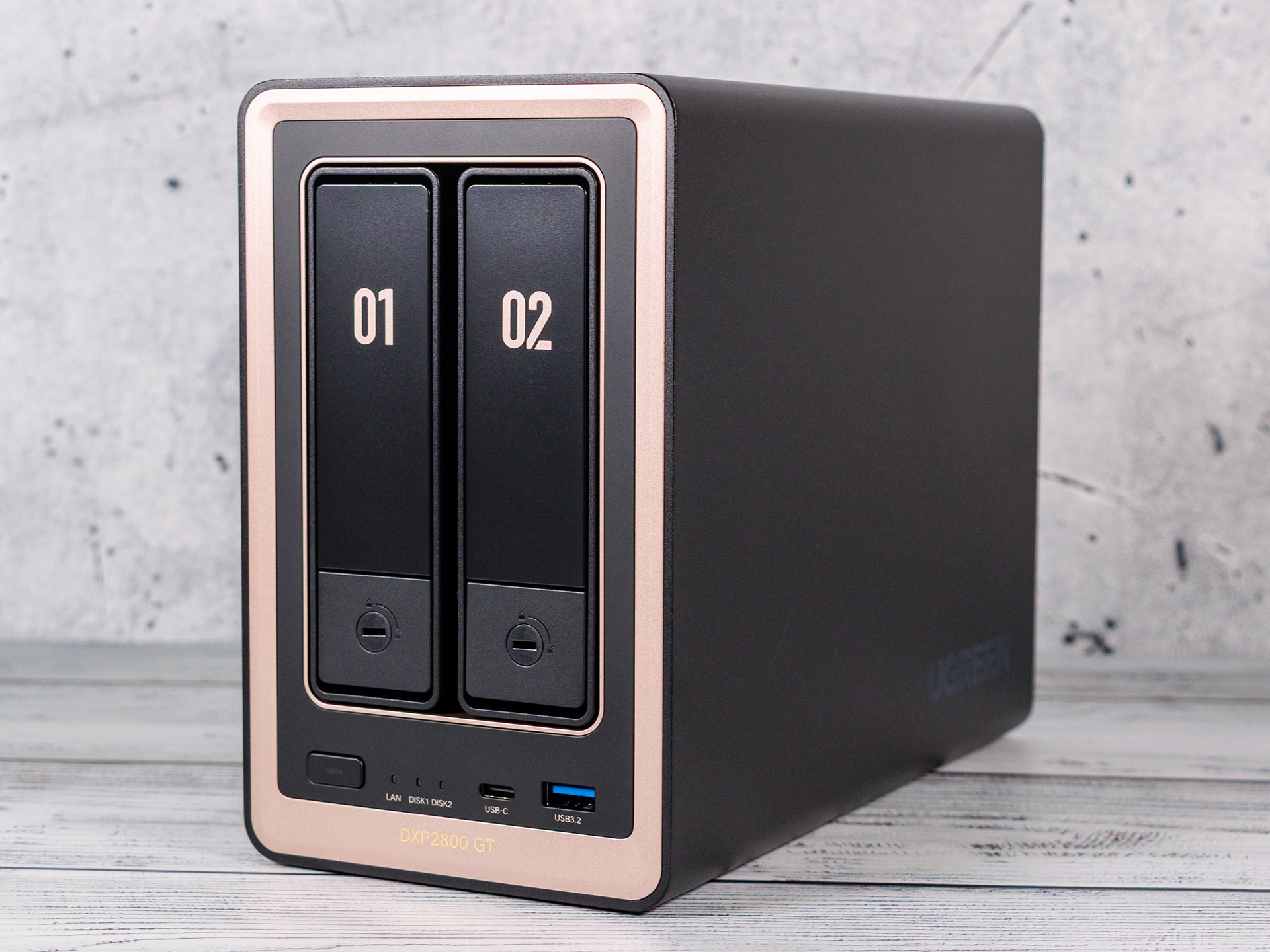
The chassis measures 231.8 x 109.4 x 178.4 mm and weighs 2.55 kg without drives. Inside, an AMD Ryzen Embedded R2514 provides four cores and eight threads with a maximum clock of 3.7 GHz. Ugreen installs 8 GB of LPDDR4-3200 memory, which the user can expand to 64 GB. A 64 GB eMMC module holds the operating system.
Two SATA bays accept either 3.5-inch or 2.5-inch drives, and Ugreen states a maximum capacity of 80 TB. Two additional M.2 NVMe slots can act as cache or as independent storage pools. RAID 0, RAID 1, JBOD and Basic configurations are supported.
Connectivity is unusually generous for the size. A single 10GbE RJ45 port sits on the rear, alongside an HDMI output capable of 4K, one USB 3.2 Gen 2 Type-A port and two USB-A 2.0 ports. The front panel offers USB 3.2 Gen 2 in both Type-C and Type-A form. A 72 W external power adapter is included, as are Cat. 7 Ethernet and HDMI cables. Drives and SSDs are sold separately.
Setup and the state of UGOS Pro
The device ships with UGOS Pro 1.20.0.0142. Initial configuration runs through a browser or the Ugreen NAS app, and a wizard guides users through the process. The operating system presents a desktop-style interface with an app store.
Ugreen has added features since the earlier DXP6800 Pro review, which criticized the software. A surveillance app now handles IP camera recording, and folder-level encryption is available. Volume encryption, however, remains absent. The management app includes automatic recognition, and the system supports Docker containers and virtual machines.
The app selection still trails what Synology and QNAP offer. That gap matters for buyers who depend on a mature ecosystem rather than on raw hardware.
Noise and power in everyday use
Quiet operation is a standout strength. With drives installed, idle noise measured 29.11 dB(A) at 30 cm. Load noise occasionally reached 34 dB(A), and drive access produced peaks of 41 dB(A). The fan briefly spins at full speed during startup, hitting 47 dB(A).
Power consumption is less impressive for a two-bay unit. With two WD Red drives spinning, idle draw ranged from 14.84 to 20.14 W. Full four-core CPU load measured 31.12 W, and all eight threads drew 31.15 W. Combined CPU and drive load peaked at 35.9 W.
What the 10GbE port can actually deliver
The 10GbE interface has a theoretical throughput of up to 1.25 GB/s. Two hard drives in RAID 0 are unlikely to saturate that link. Buyers who want to exploit the bandwidth need NVMe SSDs and suitable network infrastructure.
For basic file storage, the hardware is arguably excessive. The DXP2800 GT makes more sense for containers, virtual machines, media serving and small-office workloads. Cheaper and more efficient options exist for occasional backups.
Price and availability
Ugreen lists the DXP2800 GT at $459.99, against a recommended retail price of $510. It is available through the Ugreen online store and Amazon. Notebookcheck states that the review sample was supplied free by the manufacturer, with no preview of the review and no obligation to publish.













1 comment