Asus ROG Xbox Ally X20 Review: OLED Steals the Show, Performance Stays Put

The Asus ROG Xbox Ally X20 arrives as a screen-first upgrade, and in this Asus ROG Xbox Ally X20 review, Notebookcheck’s Andreas Osthoff finds plenty to praise—and one significant caveat. Released in October 2026, the handheld swaps the prior model’s IPS panel for a 7.4-inch OLED, but keeps the same AMD Ryzen Z2 Extreme processor and Radeon 890M graphics. That combination delivers a genuinely better viewing experience without a corresponding leap in gaming speed.
A display that changes the experience
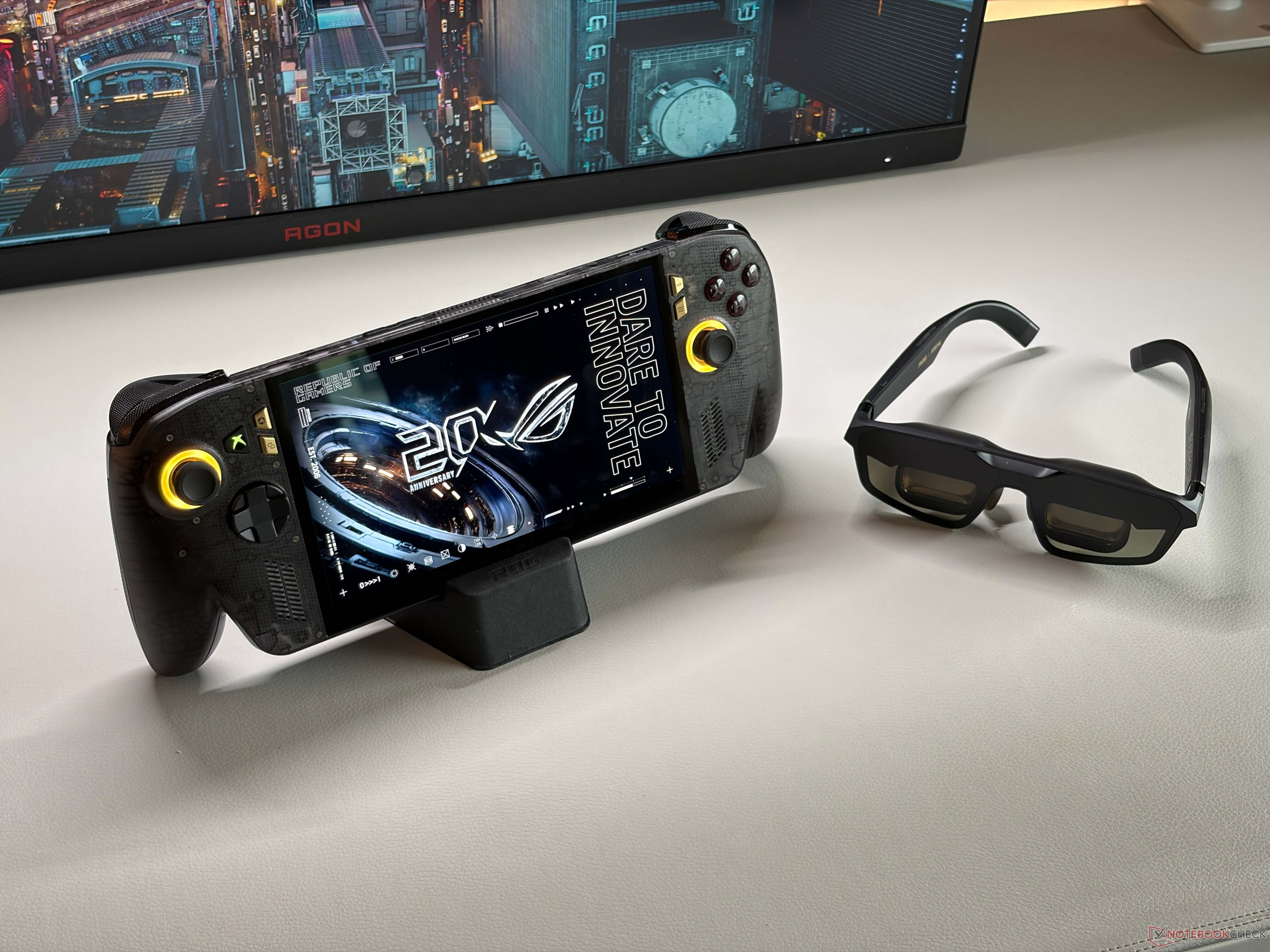
The new OLED panel is the headline act. It runs at 1920×1080 with a 120 Hz refresh rate and variable refresh support, packing 298 pixels per inch. Brightness is strong: over 600 nits in SDR and beyond 1500 nits in HDR. Measured contrast reaches 20567:1 with a black level of 0.03 cd/m², while grey-to-grey response times come in under 1.1 ms (0.94 ms black-to-white). Color coverage is excellent—100% sRGB, 99.4% P3, and 89.5% AdobeRGB. PWM flickering appears at 120 Hz with a low 11% amplitude, which Osthoff considers unlikely to be an issue in practice. He calls the OLED screen a game changer.
Design and controls: premium feel, minor quibbles
The chassis now sports a semi-translucent finish with rubberized grips and gold accents. Osthoff notes it feels premium. Sticks have been upgraded to magnetic TMR, and buttons and triggers are improved. One unit-specific issue: the d-pad on the test device had slight looseness on the left side. The Xbox button is illuminated but redundant. At 756 g and 300 x 121 x 51.3 mm, the X20 remains a substantial handheld.
Performance: familiar silicon, familiar results
Under the hood, the Ryzen Z2 Extreme (Zen 5, 8 cores/16 threads) and Radeon 890M GPU are carried over unchanged. With 24 GB LPDDR5x-8000 RAM and a 1 TB Samsung PM9C1b SSD, gaming performance is roughly identical to the previous ROG Xbox Ally X. That puts it behind the Intel Arc G3 Extreme in the MSI Claw 8 EX AI+, which Osthoff found to be about 30% faster in gaming. The Intel competitor also offers frame generation support. Power profiles range from Whisper (23/13W) through Performance (30/17W) to Turbo (35/25W on battery, 55/35W plugged in), with peak draw at 85W and sustained at 58W. Osthoff describes the performance as somewhat disappointing.
Battery life holds steady
The 80 Wh battery delivers 2–4 hours of gaming depending on the profile, and 16.6 hours in the Wi-Fi test—matching the previous model. Osthoff notes that battery life did not suffer despite the OLED upgrade.
Connectivity and storage
Ports include USB-C 3.2 Gen2, USB-C 4.0/Thunderbolt 4, and a 3.5 mm audio jack. A fingerprint reader sits in the power button. Wi-Fi 6E is on board and performs well, though Wi-Fi 7 is absent. The microSD-Express reader achieves 800 MB/s transfer speeds. The SSD is user-replaceable via an accessible M.2-2280 slot, though the cable must be handled carefully. Fans and internals are also accessible for maintenance.
Noise, thermals, and software
Fan noise reaches up to 40.2 dB(A) in Turbo mode when plugged in; Osthoff says fans are loud only in that scenario. Surface temperatures peak at 39.7°C on top and 38.9°C on the bottom. Speakers are rated at 87.8 dB with linear overall sound. Software integration and the control center are praised, and no stability issues were observed. The device runs Windows 11 Home.
Price and availability
The Asus ROG Xbox Ally X20 is priced at $1299 USD (1399 EUR list) and is available from BestBuy. That is still cheaper than the MSI Claw 8 EX AI+ at $2099. The test unit was bundled with XREAL R1 glasses and shipped without a PSU; a 100W charger is recommended. Notebookcheck awards an overall rating of 88% (very good), with a gaming performance sub-score of 76%.












1 comment